What if a family outing could do more than entertain your child?
What if every butterfly they watched emerge, every insect they observed, and every question they asked was helping shape the kind of person they become?
At Thanksgiving Point, we believe learning isn’t just about facts—it’s about developing character. Every discovery center is intentionally designed to help children build lifelong skills that prepare them for school, relationships, careers, and an ever-changing world.
At the Butterfly Biosphere, children aren’t simply learning about butterflies and insects. They’re developing the habits of curious thinkers by practicing our four Growing Characters traits:
-
Be Open
-
Observe
-
Be Comfortable with Uncertainty
-
Ask Questions
These aren’t just skills for a day at the museum—they’re skills that help children become confident learners for life.
Why Character Development Matters Just as Much as Education
Research consistently shows that curiosity is one of the strongest predictors of lifelong learning. Curious children become creative problem-solvers, resilient thinkers, and confident explorers because they learn to embrace new experiences instead of fearing them.
At the Butterfly Biosphere, every exhibit is intentionally designed to encourage exploration through hands-on discovery. Rather than memorizing information, children experience science firsthand by making observations, asking questions, and discovering answers alongside their families.
The result? Learning that lasts long after the visit ends.

Be Open: Every Discovery Begins with an Open Mind
Curiosity begins when children feel safe enough to explore.
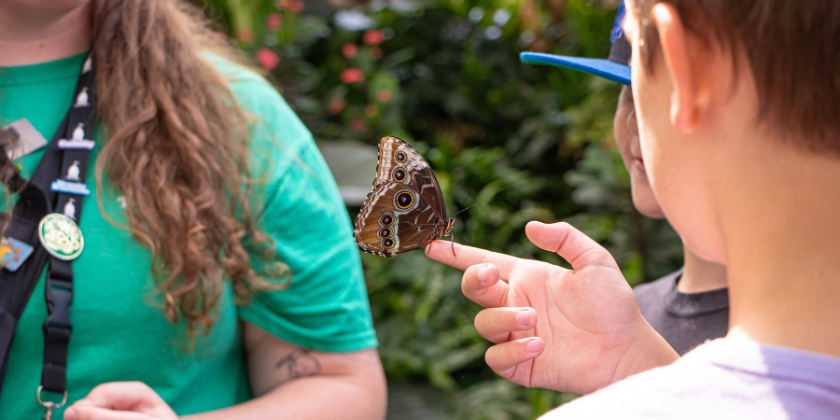
As your family walks through Utah’s only butterfly conservatory, children naturally slow down, look around, and begin discovering the world at their own pace.
Some children will spend several minutes watching butterflies land on flowers. Others may become fascinated by beetles, spiders, or stick insects. Every child experiences the Biosphere differently—and that’s exactly the goal.
Instead of directing every moment, families are encouraged to follow their child’s interests.
Maybe your child wants to spend twenty minutes watching butterflies emerge from their chrysalis.
Maybe they’re fascinated by how a leaf insect blends into its environment.
Maybe they’re simply captivated by the sound of wings fluttering overhead.
Every one of these moments builds confidence because children learn that their curiosity matters.
Parents can encourage openness by saying things like:
- “That’s an interesting idea.”
- “Let’s explore that together.”
- “I love how you’re noticing something different.”
When children know there’s no “wrong way” to explore, they become more willing to try new things, solve problems, and think creatively.
Observe: Learning Starts by Looking Closer
Butterflies teach one of life’s greatest lessons:
Sometimes the smallest details tell the biggest stories.
The Butterfly Biosphere naturally slows families down.
Instead of rushing from exhibit to exhibit, children are encouraged to look closely.
What colors do you notice?
How are the butterflies moving?
Why does one insect camouflage itself while another stands out?
Observation becomes an adventure.
As children use their senses to notice movement, color, texture, sounds, and patterns, they’re strengthening one of the most important scientific skills they’ll ever develop.
Parents can deepen the experience by asking:
- What do you notice?
- What surprises you?
- What do you hear?
- What do you think is happening?
- Let’s look a little closer.
Observation teaches children that discovery isn’t about finding answers quickly—it’s about paying attention.
And often, the more closely they look, the more fascinating the world becomes.
Be Comfortable with Uncertainty: It’s Okay Not to Know
One of the greatest gifts parents can give their children is permission to say:
“I don’t know.”
Children often believe adults have every answer.
But real learning happens when families discover answers together.
At the Butterfly Biosphere, questions naturally arise:
Why do butterflies have different wing patterns?
How do insects camouflage themselves?
Why do some bugs change colors?
How can butterflies fly such long distances?
Sometimes the answer isn’t immediate.
And that’s okay.
Instead of ending the conversation, uncertainty becomes the beginning of exploration.
Try saying:
- “I wonder why that happens.”
- “Let’s figure it out together.”
- “I’ve never thought about that before.”
- “What clues can we find?”
Children who become comfortable with uncertainty are more willing to experiment, take healthy risks, and keep learning—even when something feels challenging.
Instead of fearing mistakes, they begin seeing them as opportunities to discover something new.
Ask Questions: The Heart of Every Great Discovery
Every scientist, engineer, inventor, and explorer began with a question.
The Butterfly Biosphere is designed to inspire those questions.
Instead of simply reading exhibit signs, children naturally begin wondering:
Why do butterflies land on some flowers but not others?
Why does this insect look like a stick?
How do butterflies know where to migrate?
Why do insects have so many different shapes?
These moments of wonder are exactly what we hope to create.
Rather than providing every answer immediately, we encourage families to explore together.
Simple questions like:
- What do you think is happening?
- What else do you wonder?
- Why do you think that?
- What might happen next?
help children build critical thinking skills that extend far beyond the museum.
Because every great discovery begins with a simple question.
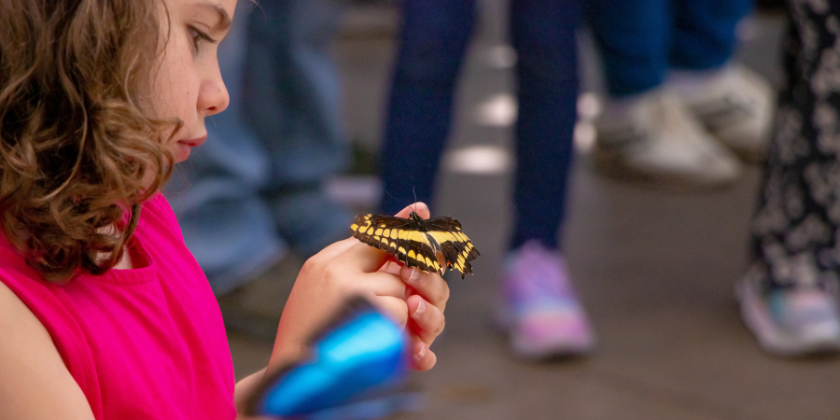
More Than Butterflies—A Place Where Character Grows
The Butterfly Biosphere is filled with incredible insects, beautiful butterflies, and fascinating science.
But the real transformation isn’t happening inside the exhibits.
It’s happening inside every child who learns to slow down, notice more, stay curious, embrace uncertainty, and ask thoughtful questions.
Those are the skills they’ll carry into classrooms.
Into friendships.
Into careers.
Into every new challenge they’ll face.
That’s why Thanksgiving Point’s mission goes beyond creating fun family experiences.
We’re helping grow curious, compassionate, and confident children—one discovery at a time.
Plan Your Visit to the Butterfly Biosphere
Whether you’re looking for educational activities in Utah, things to do with kids near Salt Lake City, or hands-on STEM experiences that inspire curiosity, the Butterfly Biosphere offers an unforgettable adventure for the whole family.
Come discover thousands of butterflies, fascinating insects from around the world, interactive exhibits, and daily STEM programs—all while helping your child build lifelong character traits through exploration.
Purchase your Butterfly Biosphere tickets today and discover why some of the most meaningful learning happens when curiosity takes the lead.